Powered By Blogger

Monday, August 6, 2018

DIFFERENT TYPES OF TOOTHBRUSHES -Part 1

https://offerforge.net/?a=28162&c=322012&s1=


Last week's Blogpost covered a very interesting subject; i.e THE HISTORY OF TOOTHBRUSHING.
And I would like to build on that topic by discussing the different types of toothbrushes currently on the market.
So in today's Blogpost, I will answer all of your questions about the best toothbrush for your teeth, review each type of toothbrush and go over its pros and cons.

In January 2003, the toothbrush was selected as the number one invention Americans could not live without. 


To encourage good dental hygiene and to help you make sure that you're using a new, effective brush that hasn't been worn down or matted with use, most dentists give their patients new toothbrushes at every cleaning.
However, is the toothbrush your dentist gave you really the best for your dental and oral health needs? How can you tell which brush is right for you?


TYPES OF TOOTHBRUSHES

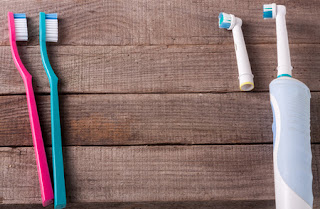
Manufacturers have come up with many different types of toothbrushes. There are two broad classifications of toothbrushes: manual and elecric.
Before you even get to electric toothbrushes, the manual ones will offer you very many types.


MANUAL TOOTHBRUSHES

Manual toothbrushes are operated by hand. 
Classifications of manual brushes are based on:

  1. Hardness  - The hardness of the bristles varies, and this is very important to check                            when buying a toothbrush. 
            Soft:     For most people, a soft toothbrush is recommended since it is easier                             on the gums and teeth. 
           Medium: Medium types are good enough for people with average dental                                      conditions.                     
          Hard:     Hard bristle toothbrushes are quite difficult to find on the market now                             because of the increasing preference for softer alternatives. The                                   hard bristles are likely to cause gum recession, lesions, and                                           bleeding, depending on how much force you use when cleaning your                             teeth.                                                                                                                                                         
  2. Shape of head -Toothbrush heads can either be conventional or diamond shaped.                                                                                                                                              DIAMOND-SHAPED     

                                Diamond shaped toothbrushes have narrow                                  tips. This shape allows the bristles to get to                                    the back and sides of your molars.                                                                                                                                                                                                                                                                                                                                                                                                                                                                                                                                                                                                                                                                                                                                                                                                                                                                                     ------------------------------                                                                                                                                                                                                            CONVENTIONAL-SHAPED                      

                                                                                              Conventional toothbrush heads are larger than diamond shaped brushes. Very large heads could pose a challenge when cleaning the molars and premolars.                      
                                                                                                                                                                                                                                                                                                                                                                                                                                                                                                                                       
  3. Bristle Pattern -Dental associations have set standards for the design of toothbrush                               bristles. For example, the bristles can't be made with sharp edges.                                 The bristles should also not fall off under normal use.                                                                                                                                                                                                                                                                                                                                 
  4. Handle design -Handles for toothbrushes vary from basic to quite complex designs.                               Manufacturers are free to come up with creative handle design.                                     Choosing the design should mostly be based on whatever you find                                 convenient and comfortable.                                                                                             The handle should be thin enough to fit into your mouth and in your                               hand. 
There is much more information about toothbrushes that you may find useful.
However, that is what I will leave you with for today. And in my next Blogpost, I talk more about the other types of toothbrushes that are on the market.


TIP: It is important to change your toothbrush after every three months for proper dental 
        health. In case the bristles begin to show signs of wear and tear before the three 
        months, you should replace  the toothbrush sooner. You can try different shapes and 
        sizes to find a brush feel that most comfortable in your mouth.


Friday, August 3, 2018

DIFFERENT TYPES OF TOOTHBRUSHES -Part 2

https://offerforge.net/?a=28162&c=322012&s1=


The last Blogpost was very popular with readers.
And this post is a continuation that give some more information. Today I will talk about the electric toothbrushes.
A manual toothbrush works well if  you are a diligent brusher, but more and more people are opting for electric toothbrushes. 

I know it's Friday; but do pay attention...😊


ELECTRIC TOOTHBRUSHES


Also known as powered toothbrushes, these tools offer greater levels of convenience to users at all times. The brush makes quick motions that don't require the input of the user. The movement can be back and forth oscillations or rotations. Those that use the oscillatory motions require users to move the brush from tooth to tooth as they brush their teeth. Electric toothbrushes that use vibrating motions are used just like traditional alternatives. The only difference is that the brush makes the back and forth movements for you. Vibrating brushes are usually more expensive than rotating options.

Electric toothbrushes are usually controlled by motors. You don't need to buy a new electric toothbrush often. Instead, you should simply replace the brush head. As in the case of manual toothbrushes; this should be done evey three months for optimal outcomes. 

Powered toothbrushes do have to be recharged, since they run on electricity. And their battery lives vary.
If you intend to travel with your toothbrush, you should remember to carry it's charger too.
Powered toothbrushes can offer you greater convenience. They can be used to time your brushing sessions and sense how much pressure you are using. To reduce the discomfort of the vibrations, you can go for brushes with soft grip handles.

TIP: 
Dentists and manufacturers come up with great ideas and designs for toothbrushes. These are meant to make toothbrushing simpler, more comfortable and convenient.
But always remember to replace your toothbrush as soon as the bristles start to wear.
And you should always select the most comfortable and efficient toothbrush.

Friday, July 20, 2018

THE HISTORY OF TOOTHBRUSHING


Toothbrushing: Toothbrushing is the act of scrubbing teeth with a toothbrush equipped with      toothpaste. That is the dictionary definition.
It is also the mechanical removal of micro-organisms from the tooth surface, using a brush and toothpaste.

Toothbrushing forms a very important part of our daily Oral Hygiene routine.
And since today is Friday, I thought I'd write today's Blogpost as a fun history lesson...
So -welcome to class.


HISTORY

As long ago as 3000 B.C., the ancient Egyptians constructed crude toothbrushes from twigs and leaves to clean their teeth. Similarly, other cultures such as the Greeks, Romans, Arabs and Indians cleaned their teeth with twigs. Some would fray one end of the twig so that it could penetrate between the teeth more effectively.


The modern toothbrush was developed in England in 1780.
While languishing in jail, William Addis decided to drill holes into a sheep's tibia, and pulled the bristles of boar hair through this bone. So picture the handle as the sheep's bone and the brush portion as  made from swine bristles.
In 1844, the first 3-row bristle brush was designed.


Natural bristles were the only source of bristles until Du Pont invented nylon. The invention of nylon started the development of the truly modern toothbrush in 1938, and by the 1950s softer nylon bristles were being made, as people preferred these. The first electric toothbrush was made in 1939 and the first electric toothbrush in the US was the Broxodent in 1960.


Today, both manual and electric toothbrushes come in many shapes and sizes and are typically made of plastic molded handles and nylon bristles.


Wednesday, July 18, 2018

DESENSITIZING TOOTHPASTES


I trust that you enjoyed last week's Blog article on tooth sensitivity. 
And I hope that my readers found it informative. 
Well, this week I want to give you a little bit more information about how desensitizing works.  
In the post on tooth sensitivity, I recommended using a toothpaste specifically designed to relieve the condition. These toothpastes are actually desensitizing agents. And this is how they work:


How does desensitizing toothpaste work?

Desensitizing toothpaste contains compounds that help block transmission of sensation from the tooth surface to the nerve channels at the centre of the tooth. The main compound ingredients that manufactures use are strontium chloride and potassium nitrate. These compounds help block the transmission of pain signals from the surface of your tooth to the exposed nerve channels.
These nerve channels get exposed as a result of the damaged tooth enamel.


Image result for Potassium nitrate as desensitizing toothpaste


It usually requires several applications before the sensitivity is reduced. So it is not something that happens overnight. 
Desensitizing toothpaste usually take a month of regular use to decrease pain. 
Remember to brush twice a day with your densiting toothpaste. 


Image result for how does desensitizing toothpaste work


Friday, July 13, 2018

TOOTH SENSITIVITY

https://offerforge.net/?a=28162&c=315733&s1=


Tooth sensitivity is one of the most common dental problems reported by patients globally.
Also known as dentin hypersensitivity, tooth sensitivity occurs when the root surfaces of teeth are exposed. This occurs when the enamel that protects our teeth gets thinner, or when there is gum recession.  The underlying surface, the dentin are then exposed. And this reduces  the protection the enamel and gums provide to the tooth and root.


Causes of tooth sensitivity

There are many causes of tooth sensitivity, including:
  • Worn tooth enamel from using a hard toothbrush or brushing too aggressively
  • Tooth erosion due to highly acidic foods and beverages
  • Tooth erosion due to bulimia or gastroesophageal reflux disease (GERD)
  • Gum recession that leaves your root surface exposed


Prevention of tooth sensitivity

The following are some at-home treatments that are commonly advised by dental professionals:

  • Desensitizing toothpaste. There are several brands of toothpaste for sensitive teeth available. Your dentist may recommend one or you may have to try different brands until you find the product that works for you. Be sure to use fluoridated toothpaste for sensitive teeth, not tartar-control toothpaste. Try spreading a thin layer of the desensitizing toothpaste on the exposed tooth roots before bed.
  • Use a soft-bristled toothbrush.
  • Avoid highly acidic foods.
  • Use a fluoridated mouthwash daily.
  • Avoid teeth grinding. Consider getting a mouth guard.

Treatment of tooth sensitivity

If you have sensitive teeth, don’t neglect your daily oral care routine. Just be sure to use a soft toothbrush and soft floss. You can also try a toothpaste designed for sensitive teeth. Several brands are available, and you should notice some improvement with regular use of any of them. Also, try spreading some sensitizing toothpaste along the exposed cementum or dentin area before bed to help reduce sensitivity. Just use your fingertip or a cotton swab to rub the toothpaste directly onto the exposed spot.

  In addition there are some dental procedures that may reduce tooth sensitivity:
  • Bonding, crowns or inlays. These may fix a tooth flaw or decay that is causing sensitivity.
  • Fluoride gel or varnish.
  • Surgical gum graft. This will protect the root and reduce sensitivity if the gum tissue has eroded from the root.
  • Root canal. This is a last-resort treatment for severe tooth sensitivity that has not been helped by other methods.


Wednesday, July 11, 2018

FLOURIDE ALLERGY

https://offerforge.net/?a=28162&c=315733&s1=


Alright. So last week something interesting cropped up in my Blogpost -Flouride allergy
A lot of people informed me that they have not heard of it before. So here it is:

What is Flouride-allergy?

Studies have shown that some people are sensitve to Flouride. Although fluoride -allergy is rare, it can be very dangerous to people who have it.
These hypersensitivity reactions usually disappear promptly after discontinuation of the fluoride.


What are the symptoms of Flouride-allergy?


  •  In hypersensitive individuals fluorides occasionally cause skin eruptions such as atopic dermatitis, eczema or urticaria.
  •  Gastric distress, headache and weakness have also been reported. 


How is Flouride- allergy treated?

  • Antihistamines are commonly prescribed by doctors,  and usually takes effect in 15 minutes.
  • Prevention of foods with excess fluorides like sodas, bottled juices, processed cereals, chicken and fishes.
  • Avoid tap water which is rich in fluoride, instead choose distilled or reverse-osmosis bottled water.

How to avoid Flouride-allergy

The best way to prevent an allergic reaction to fluoride is to avoid exposure altogether.
  1. Know the sources.
  2. Replace flouridated items with non-flouridated ones.
  3. Choose a dental practice that understands the risks associated with flouride.


Thursday, July 5, 2018

TOOTHPASTE -Fluoride? or Fluoride-free?


https://offerforge.net/?a=28162&c=315733&s1=


The most important step to healthy teeth and gums is to brush and floss properly daily.     Fluoride is added to toothpaste, mouthwash, community water supplies and prescribed in pills to help prevent tooth decay.  
However, there are instances when dental professionals would recommend the Fluoride- free toothpaste.
Patients who have dental fluorosis, do not need more fluoride and may prefer a toothpaste that does not contain fluoride.
Patients who are allergic to toothpaste should definitely opt for to a fluoride-free toothpaste.
Children under the age of two  can swallow too much fluoride; because at this age it is difficult to teach them to spit the toothpaste out. So a fluoride-free kiddies toothpaste would be ideal.

More natural toothpaste options are popping up in the market, and many of these are fluoride-free.